


Stephanie Hepburn is a writer in New Orleans. She is the editor in chief of #CrisisTalk. You can reach her at .
Four years ago, Gabriela Solis Torres, assistant director of criminal justice at the Harvard Kennedy School Government Performance Lab, received a call from Harris County chief deputy Mike Lee, then assistant chief. She was a criminal justice fellow for the lab working on a project with Harris County at the time and recalls Lee telling her the moment was primed for the jurisdiction “to get creative” finding ways to divert quality-of-life — mental health, substance use, homelessness and other social welfare challenges — calls from a police response. Since then, the lab has provided pro bono technical assistance to over 30 local governments and recently released a free, publicly available metrics tool designed to help local governments identify the metrics they need to track, set and achieve targeted goals, and expand their unarmed alternative response programs.
In 2020, the United States was experiencing what Solis Torres calls a “perfect storm” — a global pandemic and corresponding mental health stressors, the murder of George Floyd by Minneapolis police officers and increasing pressure on communities to divert quality-of-life 911 calls from law enforcement.
Lee and his team had been looking into Oregon’s Crisis Assistance Helping Out on the Streets framework, commonly known by its acronym, CAHOOTS. The model started in 1989 and uses a two-person team — a medic and a behavioral health worker — to respond to mental health and substance use 911 nonemergency calls. “That gave Harris County a model to build off of,” said Solis Torres. What resulted is Harris County’s Holistic Assistance Response Teams, HART for short.
Since March 2022, the teams of social workers and EMTs have responded to nonemergency 911 calls, diverting people experiencing quality-of-life challenges from law enforcement and hospital-based interventions — people who otherwise might be arrested for misdemeanors related to their struggles — and connecting them to services. Many mental health-related 911 calls are requests for welfare checks or reports of trespassing or disturbance.
Harris County has long focused on the intersection of mental health and the criminal legal system. The Sheriff’s Department is a peer-to-peer learning site for the Council of State Governments Justice Center’s Justice and Mental Health Collaboration Program, jurisdictions selected for demonstrating best practices when responding to behavioral health issues and homelessness. In 2020, the county launched a public jail dashboard that gives a snapshot of the demographics of those incarcerated, including whether they were identified as having mental health needs. Sheriff Ed Gonzalez told the Texas Standard that the dashboard was designed to provide transparency for the public and lawmakers regarding the county jail population. On May 4, the dashboard illustrates the jail’s disproportionate incarceration of people who are Black (close to 50%) and those experiencing mental health challenges (roughly 80%).
“We operate, in essence, the largest mental health facility in the state, and, in my opinion, jails are not the best place to be dealing with that type of medical issue,” he told the Texas Standard. “That should be treated as a public health issue, not as a criminal justice issue.”
Solis Torres says the sheriff’s office and the county government wanted to develop 911 diversion that went beyond solely focusing on obvious 911 mental health and substance use calls. “They asked how they could address scenarios landing in 911 but that weren’t meant to be handled by law enforcement,” she said, adding that operators often got calls from people who needed referrals or had a social service need. “They wanted to create a program that would respond to 911 calls to help residents experiencing homelessness, behavioral health issues, or any nonemergency health or social welfare concerns.”
She and her team began at Government Performance Lab researching what other communities were doing, reaching out to local governments running diversion pilots. They quickly realized many jurisdictions were learning as they went and needed support. “Those conversations turned into, ‘Wait — you’re giving TA [technical assistance] on alternative response? We need help too,’” she recalled. The lab responded by expanding its support and putting together government cohorts to help more jurisdictions implement or expand their alternative response programs.
After working with 32 jurisdictions and examining data from another 17 alternative emergency response programs, Solis Torres and her team discovered that while all communities are unique, the challenges often aren’t. Most collected data but frequently struggled with what they should track and how to review data to further their objective of delivering social services to their residents. “The point isn’t to have pretty data but to develop data-driven, action-oriented approaches that allow stakeholders to review data at high frequency and make action plans to iterate, change or test,” she said.
She shares that jurisdictions often stop at data collection. “In our experience, we find that it’s really difficult for government leaders to take action based on their data — people are busy and it’s hard to find the time to talk about data when you’re in the thick of day-to-day operations,” she said, adding that the lab helps local governments prioritize data-driven performance management of their programs.
Solis Torres and her colleagues have recently released Essential Metrics for Alternative Emergency Response Programs, a tool designed to help local governments develop, implement and expand their alternative response programs. They prioritized 29 actionable metrics; each directs users to the common data sources, priority level and review frequency. For instance, if a jurisdiction wants to examine calls that could have been diverted to alternative response teams but weren’t, the metric recommends reviewing 911 and alternative response dispatch system data monthly to see what happened. That would help the local government identify if calls were triaged incorrectly or if no team was available at the time of the call. The feedback loop also allows for course correction. “If the program usually gets 200 calls from 911 but this month received only 50, you should be able to see that quickly and try to troubleshoot,” she said.
Sometimes, governments are trying to answer specific concerns like whether there are disparities in who receives police versus alternative response — that’s why the tool is also organized by core questions. Regarding disparities, the tool suggests jurisdictions examine five metrics: service recipient demographics, staff demographics, complaints, repeated need and recipient feedback.
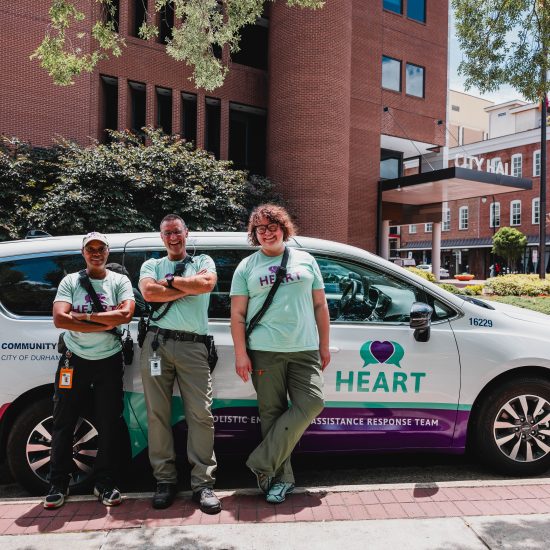
The tool includes tangible examples like the public dashboard for Durham’s Holistic Empathetic Assistance Response Teams, also called HEART, an alternative response program the lab helped launch. So far this year, the program has responded to 3,232 calls. The dashboard tracks what response people received — unarmed community response team, crisis call diversion by a crisis call counselor, co-response from a police officer and clinician or follow-up care. Under each response, the dashboard highlights primary call types. The top reasons for dispatching unarmed community response teams have been calls reporting trespass, mental health crisis, nuisance or intoxication or a request for a welfare check.
Some local governments have 911 call centers and behavioral health professionals co-locating to help identify and triage calls to alternative response teams. Jurisdictions like Baltimore and D.C., transfer eligible calls from 911 to 988 contact centers — 988 is the nationwide number for mental health and substance use crises. In D.C., a 911 call taker and dispatcher triage calls, diverting those eligible for a mobile crisis team to 988. However, some staff from Access HelpLine, the crisis line that answers 988 calls in D.C., have recently been embedded at the 911 call center.
The teams themselves also vary. Unlike traditional mobile crisis teams, Solis Torres points out that alternative response teams are designed to respond to behavioral health calls and those related to quality of life concerns. Programs use a mix of behavioral health and medical professionals — crisis counselors, bachelor-level social workers, peer support specialists, clinicians, nurses, EMTs, and paramedics — to staff their teams, though some jurisdictions use mobile crisis teams as their alternative response.
Many jurisdictions are moving toward alternative response functioning as a fourth emergency response branch. In doing so, many teams have the same technology as police, EMS, and the fire department, including integration with the public safety answering point’s computer-aided dispatch system, commonly called CAD. “The teams have mobile data terminals in their vehicles and radios that connect to dispatch,” she said. “They see eligible calls in the queue and take the call just like a police officer would a burglary call — they’re really set up like any other emergency response.”
She points out that integration with the 911 system has many benefits, often improving diversion of mental health, substance use and quality of life calls through close partnership and data feedback loops between emergency response teams.
Applicants for the Government Performance Lab’s pro bono technical assistance are often the office of behavioral health or public health — whatever department houses the alternative response program — and the 911 emergency communication centers. “That might be the emergency communications director or the police chief if 911 is run through the police department,” she said, adding that sometimes the applicant is the mayor’s office, especially if the program is early in development or a pilot.
In Harris County, the lab worked closely with the sheriff’s office and the public health department. The latter runs HART, the alternative emergency response program. “Our goal is to help whoever we can within the government to set up these teams — most of the time, that’s interdepartmental,” she said. “What people underestimate about these teams is that to make them successful, it takes a lot of collaboration and oftentimes, these departments speak different languages. We try to help with that.”