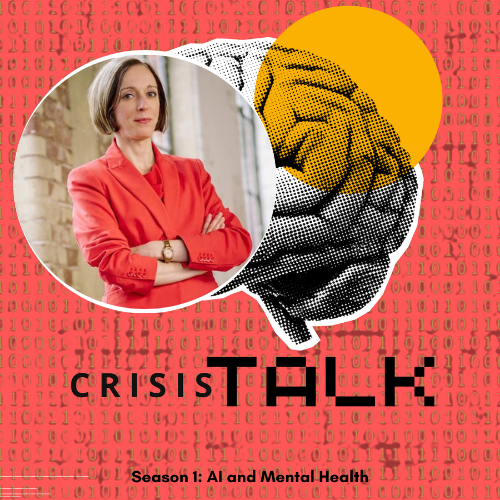



Stephanie Hepburn is a writer in New Orleans. She is the editor in chief of CrisisTalk. You can reach her at editor@crisisnow.com.
Big news over here at CrisisTalk. We’re a Signal Awards finalist. That also means we are eligible to win a 2026 Signal Listener’s Choice Award. We need your help. If you’ve enjoyed listening to CrisisTalk, please VOTE for us. Voting is open now through Thursday, October 15th at 11:59 pm PST.
New study finds nearly a fifth of adolescents and young adults turning to AI chatbots for mental health advice. A conversation with RAND senior health policy researcher Ryan McBain on the study and whether youth may be sidestepping the skill building they need to navigate identity formation, friendships and dating.
Transcript
Ryan McBain: AI chatbots aren’t sitting outside of the mental health system waiting for experts or policymakers or whatever to decide whether to let them into to mental health care. Like they’re already part of the ecosystem. I think it would be very, very hard.
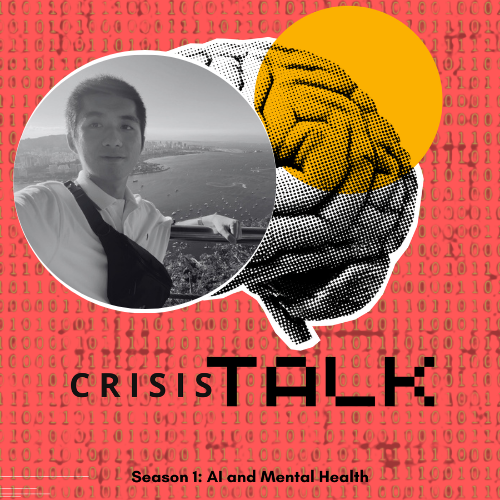
Stephanie Hepburn: This is Crisis Talk. I’m your host, Stephanie Hepburn. Today I’m speaking with Rand senior health policy researcher Ryan McBain on how more young people are using AI for mental health help. His latest research found that nearly a fifth of adolescents and young adults, ages 12 to 21, reported turning to AI chatbots for mental health advice, with over 40% of youth doing so monthly or more. We discuss how young people may be sidestepping the skill building they need to navigate identity formation, friendships, and dating. Let’s jump in.
Ryan McBain: I’m Ryan McBain. I am a health policy researcher at RAND, which is a nonprofit, nonpartisan think tank. And I’m also an assistant professor at Harvard Medical School. For the most part, my work focuses on adolescent and child mental health, specifically focused around access and quality of care, and in many instances, policies. It’s part of my policy researcher title to evaluate policies and programs and see if they’re having the impacts that we hope that they would in mental health.
Stephanie Hepburn: Ryan, so your recent study found that nearly a fifth of adolescents and young people reported using AI chatbots for mental health advice. And with 40% of youth actually doing so monthly or even more than that, uh, what were you trying to answer? What was the question that you were trying to answer with this study?
Ryan McBain: Yeah, I mean, I think you’ve already sort of hit the nail on the head. We were most interested in just characterizing how broad, widely used AI is for this purpose. Uh, there’s sort of thought there, right, that if we discover that lots of people are using it this way, then it puts some pressure on Congress or uh local policymakers to act now to try to ensure that there are appropriate safeguards and quality measures in place because a lot of people are already using it this way. And we certainly found that.
Stephanie Hepburn: How many youth were included in the study?
Ryan McBain: It was a nationally representative survey of about a thousand young people ages 12 to 21. And we tried in the way that we did the sampling for it to be nationally representative so that we could actually scale it and make estimates at a national level. One of the estimates that we were able to achieve based on our sampling method was that over 8 million young people are using AI chatbots for mental health advice.
Stephanie Hepburn: Are we talking about general use chatbots or those tailored specifically for mental health?
Ryan McBain: Yeah, so we didn’t limit it one way or the other, but we gave examples like ChatGPT or Claude made by Anthropic or Character AI or Snap AI. So it was largely framed around general purpose AI chatbots like those, as opposed to purpose-built chatbots for mental health.
Stephanie Hepburn: And then did you specify which platform they’re using or which model they’re using for the large language models?
Ryan McBain: Yeah, it’s a good point. We didn’t actually ask for specifically which platform they were using. It might be something we add in a subsequent round of the survey, but it’s a little bit brass tacks, but essentially we have sort of limited real estate in the overall survey architecture of RAN to ask questions.
Stephanie Hepburn: So, Ryan, you did a study like this last year. Is that correct?
Ryan McBain: Yeah, that’s right. The first time we did it, it was November of 2024. And at that point, we found that one in eight young people reported having used AI for mental health advice. And then we did it again a year later, November of 2025, and we found that it had increased to one in five. So it was roughly a 40% increase in relative terms just in a single year. It was pretty rapid adoption. And then we’re gonna be doing this again in November of this year, 2026, and then again in 2027, et cetera. So it should give us a pretty good time trend to see how uh usage is evolving.
Stephanie Hepburn: Ryan, have you added questions along the way?
Ryan McBain: Yeah. So we first did it in 2024 and we only had a few questions at that time. So we basically asked, have you used AI chatbots before? If so, have you used it for mental health advice? And then we asked how often and whether they found the advice to be helpful. In 2025, when we updated the survey, we used the same questions, but we also added questions about disclosure. So have you told anybody that you’ve used an AI chatbot for mental health advice? And then we also asked if they had sought mental health advice from a clinician in the prior six months. And that sort of allowed us to look at it from the lens of whether an AI chatbot might be used as a substitute. So instead of seeking advice from a human or as a complement, right? So in addition to talking to humans, I’m also talking to an AI chatbot.
Stephanie Hepburn: Yeah, I thought that part was incredibly interesting. I’ve been wondering when it comes to adoption and specifically people asking questions or asking queries to the chatbots about mental health, whether this is being used in a supplementary way or if it’s being used in lieu of mental health support, professional mental health support. And so what did you find? What was the result?
Ryan McBain: Yeah. So the way that the survey is structured gives us sort of uh one set of insights, but not everything that we would like to have. So what it was able to tell us is that among teenagers, young people who are engaging with a physician about mental health needs, they’re more likely to be using an AI chatbot in addition for discussing mental health. And so in that sense, you could sort of see it as a complement rather than a substitute. But what it doesn’t really tell us is, you know, we we didn’t ask directly to basically say, hey, have you used AI as an alternative to humans, right? Even if somebody’s talking with a therapist, let’s say over the past six months, they still might be using it in a substitutionary way, right? Maybe they would have talked to the human therapist more often were it not for the fact that they’re also using AI. Um, so there are some nuances like that that’s really hard to tease out with the type of survey as uh as we’re using it.
Stephanie Hepburn: Yeah, that makes sense. I mean, I’d be curious as to whether there were parts of the conversations that they were having with chatbots that they felt more comfortable having those discussions with the chatbots as opposed to their therapists. So I am curious. Is that something that you’re gonna expand on for next time? Or what are you gonna do next with the survey?
Ryan McBain: Yeah, it’s tricky uh to ask it in a quantitative survey. You’d we’d basically need to ask probably four or five questions to disentangle some of the nuances. What we are doing separately is qualitative interviews with college-age folks to understand their behavior patterns. So asking specifically young people who self-report using AI for mental health, in which case you could just directly ask them, right? Have you used AI instead of humans? And if so, why? You know, what were the barriers? Or, you know, maybe just is one speculation would be, for example, there are certain types of conversations that maybe are more embarrassing to have with an adult, or maybe you just want an immediate response. Maybe it’s not something about emotion regulation or behavioral activation or something that’s really science-y, and instead it has to do with a really frustrating conversation that you had with one of your best friends, and you’re trying to figure out how to navigate that really complicated social landscape. And you have an AI chatbot in your pocket, and so you can just pull it out and get its advice really quickly.
Stephanie Hepburn: Yeah. So have you do you have any findings from those conversations?
Ryan McBain: No, there’s they’re still ongoing. And so, I mean, I could certainly speculate, but we’ll want to do some more formal thematic content analysis before we draw any broader conclusions. But it’s certainly a really interesting area to figure out why are people using AI chatbots over time and not just if they like them, but if they actually feel like they are getting other types of benefits, clinical or otherwise. Uh, because we have asked this question about whether or not you find the responses to be helpful. So not helpful, somewhat helpful or very helpful. And the overwhelming majority of young people report that they find it somewhat or very helpful, over 90%. So that in of itself is fairly positive, but people might find AI chatbots to be helpful when in reality they’re slightly sycophantic or overly flattering or not telling people the hard truths that they need to be hearing, or they’re just giving advice that if you showed it to a clinician, they would say that’s not consistent with best practices. And so there probably are additional ways of trying to tease out that type of information.
Stephanie Hepburn: Right. And I think in addition, it’s is this helpful temporarily? Does it give, you know, short alleviation from whatever the person is experiencing? Um, or does it provide any sort of long-term benefit?
Ryan McBain: Yeah, that’s something I think about a lot is like this notion of friction and that particularly for a young person who your prefrontal cortex is still developing, you’re going through a process of identity formation. I mean, adolescence is just, at least for me, it’s it’s really socially awkward, right? Like you’re trying to figure out who your friends are, who your enemies are, you’re really stressed out about school, you’re trying to figure out what college is going to look like. And some of that, like the wrestling, the friction that comes with navigating, dating, and all sorts of stuff can be character forming. And if you can just say, oh, I don’t, you know, this is too stressful. I don’t want to think about it. I’m just gonna ask my AI companion or this chatbot and get a response and do whatever it tells me. I don’t know. Like that could be helpful in the short term because maybe you’re making a smarter decision in some way if the AI chatbot’s advice is actually good, but you’re sidestepping the important hard thinking that might be necessary for longer-term outcomes that would be quite positive.
Stephanie Hepburn: Right. You’re offloading that decision making, but it sounds like you’re also saying potentially not working on those skills that you need in order to make those decisions in the future.
Ryan McBain: Right. Yeah, for sure. I think dating is a good way. Just like, you know, how do I impress this person and persuade them that maybe I’m somebody who they’d want to go on a date with or whatever? And I mean, that is emotionally taxing and feels overwhelming, but is is probably an important experience to go through, as opposed to just saying, hey, ChatGPT, here’s what this girl or what this guy said, you know, how should I respond in a way that will make them laugh or or whatever, right?
Stephanie Hepburn: Right. And how how is this chatbot that has no life experience really going to give you um the information that you need to make your decision?
Ryan McBain: Mm-hmm. Yep. Yeah, that too.
Stephanie Hepburn: I wanted to know, you know, if numbers were higher among any specific demographics.
Ryan McBain: Yeah, there there were. So um we found that uh females were roughly twice as likely to be using AI chatbots for mental health advice. These are sort of adjusted odds ratios. So we were controlling for a few other things in our models, but essentially doubling. And then we also found that older adolescents were much more likely, or older adolescents and young adults, so particularly those ages 18 to 21, were much more likely to be using it for this purpose compared to younger adolescents ages 12 to 14.
Stephanie Hepburn: What other demographics did you look at?
Ryan McBain: We looked at age, biological sex, and then race-ethnicity categories, in particular black, white, and Hispanic. And we found that among chatbot users that black respondents had substantially higher odds of using the technology on a monthly or more often basis compared to white counterparts. Now, as I said, our total population was a thousand people or respondents. And so once you break that down into some of these smaller groups, the estimates are a little bit less reliable. But it certainly was a fairly large disparity in the sense that it did seem like black respondents were using it much more frequently, which I mean you could speculate maybe that has to do with the fact that black respondents have less access to human-based therapy, for example, or something of that sort. But we didn’t ask any why questions that would really tease that out in detail.
Stephanie Hepburn: And what about the gender disparities? Um, do you have any thoughts there?
Ryan McBain: Sure. I mean, I would say, you know, the most common mental health conditions among adolescents are depression and anxiety. And we know from epidemiological studies that the prevalences of those are just higher generally among females, among girls as opposed to boys. And so from that perspective, maybe it’s not quite as surprising that females are using it more often than their male counterparts. In the upcoming survey, we’re going to be administering this November, we are going to be asking questions from the PHQ-4 to get a sense of people’s levels of depression and anxiety and see how that relates to their usage over time.
Stephanie Hepburn: Your study illustrates that AI chatbots, they’re already embedded in what you call the youth mental health information ecosystem. What do we do with that information? We can see it, we know it’s happening. But what does this mean for parents and for clinicians?
Ryan McBain: Yeah, I mean that’s that’s exactly right, right? I mean, AI chatbots aren’t sitting outside of the mental health system waiting for experts or policymakers or whatever to decide whether to let them into mental health care. Like they’re already part of the ecosystem. We’re not going to be able to really go back on that in a fundamental way. And I think if we tried to by fully removing AI chatbots altogether from adolescents’ lives, I think it would be very, very hard. I mean, there are already examples, for example, in Australia where they’ve tried to introduce uh a ban on social media and kids just use VPNs or other ways of sidestepping the types of barriers that they’ve been putting in place. But yeah, I mean, I think from a clinician or parent perspective, the most important thing is to try to talk to adolescents about it in a non-judgmental way. I don’t think that putting pressure on young kids, making them feel shame is going to be effective. I also don’t think that a blanket ban on AI chatbot use overall is particularly strategic either. And it really could be the case that these AI chatbots, for 90% of the time, they’re actually offering great advice. It just remains to be seen. I think that there need to be better studies to demonstrate quality and safety more consistently. But setting that to the side, right, I think if I’m a parent or a clinician, the conversation would start with something like, hey, I hear a ton of young people today are using AI to help them navigate all sorts of complicated things, relationships, uh, mental health issues, et cetera. Have you been using it in that way? And how have you found the experience to be? Uh, that type of sort of open-ended, inviting, non-judgmental line of inquiry, I would hope would allow your teenager or your patient to say, yeah, I do use it that way. I found it to be helpful in XYZ ways and not in ABC ways. And then maybe, right, once you’ve sort of listened for a while, it could create a window of opportunity to say, well, you know, just FYI, like, you know, I’m here too if you want to talk with me. And there probably are some instances in which AI chatbots could give particularly problematic advice, like people who have active suicidal ideation or psychosis, hallucinations, delusions, these sorts of things. And so yeah, just letting kids know what types of instances AI chatbots are more likely to produce high quality or problematic information, I think could also be useful.
Stephanie Hepburn: What is the onus on the chatbot companies themselves? Should they be creating a bridge to mental health services? Should that only happen when somebody is experiencing increasing suicidal ideation, both implicit and explicit communication of it? What do you feel the onus and responsibility is on the part of the AI chatbot companies to either be a bridge or standardize guardrails, as opposed to each company just deciding that on their own?
Ryan McBain: Yeah, I think there’s a there’s a large onus there for companies that operate in the private sector and are focused, at least to some extent, on profit maximization. That if there is no regulatory pressure or penalties, then very often, right, companies are gonna go where the financial incentives lead them. And so I’m not convinced that just saying, you know, wagging a finger and saying, oh, the you know, the onuses on these companies is really gonna do very much. It is possible that even without regulation, that you could imagine lawsuits similar to what’s happened with social media platforms recently. And maybe that’s enough to scare companies into acting in the public interest. But I mean, from just an abstract moral perspective, and here I’m just speaking, you know, of my own personal opinions, it would be nice to think that we can learn from some of the mistakes that we’ve made with social media and young people. And that while we’re still in the early days, the infancy of AI, uh, we can put some of these safeguards, quality uh assessment tools in place in perpetuity for future generations to thrive, that AI essentially leads to human flourishing rather than whatever the opposite of that is, right? Human immiseration or something of that sort. And I don’t think that it’s it’s terribly burdensome because, again, from my perspective, a lot of the results, a lot of the outputs that are generated by these models are quite reasonable and positive and probably quite helpful. It’s just hard to measure them. I and other people have developed uh benchmarks, evaluations to figure out how well some of these models are working. And I think that they still have quite a ways to go. I think that it’s just something that needs to be formalized and it should be in state and federal legislation.
Stephanie Hepburn: I agree. I think the regulatory approach, I think, is actually beneficial to the large language model companies as well, because instead of each company making their own determinations, it creates a standardization and an expectation of what they’re supposed to do. And they may not view it that way, but I think it actually would make things easier on those companies as well.
Ryan McBain: Yeah, and I think it’s it’s actually a little bit easier when you’re talking about young people or minors, I guess, because you know, it’s a it’s a vulnerable population a certain way. There’s still a lot of identity formation, uh, brain development, all sorts of stuff going on. And it’s you know, it’s a little bit different when you’re talking about adults who can choose to do all sorts of things that are, you know, somewhat injurious to their own health and well-being. And we allow uh more latitude for that, right? There’s sort of this uh question of people’s own autonomy and agency and not wanting to limit that. Um, so I think, you know, talking about adolescent mental health, which has been in a crisis for you know almost a decade now, is a very easy uh entry point for reasonable legislation and something that should in theory be quite bipartisan as well.
Stephanie Hepburn: One of the challenges is what does that look like, right? I’ve seen age restrictions. How well do these age restrictions work? I was listening to somebody who indicated, well, we can tell if somebody’s had this account for 16 years, we we know that chances are they’re older than 16, right? So there are these kind of tells. But the bands, the age bands, part of me is just like, how effective is that? And you mentioned VPNs, right? The kids are smart. They know how to far better than we do, know how to work around barriers. So part of it too is that I I agree that regulation really needs to be something that is viable and would lean more towards standardization than this broad brush restrictive approach.
Ryan McBain: Yeah. And I would also say that the types of regulations that I have seen introduced so far, uh, largely in state legislation, they feel like a stepping stone, but they don’t feel adequate from my perspective. So I’ll give you a couple examples, right? So in the state of California, for example, for companion AI chatbots, which even that raises a question well, what counts as a companion AI? Is ChatGPT or Claude in that camp? Or are those general purpose in a way that they’re actually gonna be able to skirt regulations? Uh, but but setting that to the side, you know, it’s like, oh, you need to remind people at a Certain intervals, right? Like, I don’t know, on an hourly basis or something like that, that, you know, oh, as a reminder, I’m not a human, I’m an AI. Maybe that does something on the on the margins, but I don’t know that it’s really going to have a massive effect. And similarly, for people who are demonstrating serious mental health needs, there’s sort of a requirement that in the chatbot response, it recommends that people contact somebody through a mental health emergency hotline like uh 988, for example. And that’s also good. I mean, that’s something. But it feels pretty skimpy to me. You know, in my view, one better would be, for example, like embedding like, hey, it sounds like you’re having a tough time. Click on this link and you can immediately talk to somebody, right? Which, you know, some of the platforms are working on those types of embedded architectures that are a bit more immediate and responsive.
Stephanie Hepburn: I interviewed Dr. Charlotte Bleece, and she was sharing the AI chatbots have become almost um like a shadow mental health provider. So you have these chatbots that are giving advice, and you have individuals turning to the chatbots for advice. And then you have a separate system of our existing mental health care system. How do we get these to interconnect? What you were sharing with, you know, for example, Chat GPT. Now you can click and it will take you straight to dialing 988 or texting 988 or chatting with 988. This is not a healthcare system, but it is where a lot of people are going. And so how do we bridge that gap and to create some sort of interconnection between those two?
Ryan McBain: Another element would be just having third-party standardized benchmarks of safety and quality and holding models accountable for achieving certain thresholds on these, right? You need to score at least a B minus on these five to ten measures. And if you don’t, then there are certain financial penalties, or your model is not going to be accessible to these vulnerable populations or whatever it might be. Another element that I think is quite important is having humans in the loop. So when people are demonstrating uh potential homicidal uh inclinations, like messaging about a school shooting or something like that, or suicidal ideation, that there are more direct ways for people who work at these tech companies to see flagged accounts and to review them, because AI isn’t always gonna get it right. I mean, there are gonna be times when conversations are nuanced in ways that it’s gonna take somebody who is on a safety team at one of these companies to look at it and make that sort of determination. It’s just a question of how many people are you gonna be dedicating to those tasks? What time horizons, you know, within 12 hours, within 24 hours, are you gonna commit yourself to? Are data on that gonna be transparent for review over time? All of these right now are pretty open-ended and are just leave to the discretion of uh each uh company.
Stephanie Hepburn: So for the studies, what do you hope to incorporate? Were any of the findings super surprising to you, or the results, were they what you expected?
Ryan McBain: Yeah, I think the results were mostly what we expected, which is we already knew from a couple of years ago that it was a fairly widely uh distributed phenomenon that young people are using AI for mental health advice. We kind of expected it to be going up over time. I don’t think we expected to see the magnitude of the jump that we observed. So that was surprising. I was also a bit surprised that so few young people had disclosed using AI in this way to other people, right? Two-thirds of uh young people hadn’t told anybody that they’d used AI this way. Um, although for people who aren’t using it that often, right, maybe it’s less surprising, right? If I’m only doing it, you know, once a year or every couple of months, it feels less like I’m keeping some secret from people as opposed to if I’m doing it daily or weekly or something of that sort. In terms of where we want to head next, I think that some of the most interesting elements are going to be looking at people’s actual mental health and observing how that links to usage and self-perceptions of whether it’s helpful or not helpful, the frequency that they’re using it. And if we we look at that over time, you know, we could ask people, let’s say in 2026, are you using AI for mental health? And do you have mental health needs according to the PHQ-4? Do we actually see that maybe there’s improvements a year later when they respond to the same survey? Do we see that the PHQ-4 score goes down over time among those who are using it more consistently? And maybe that’s a positive story there. Or maybe we don’t see that, right? And so it makes us raise our eyebrows. I I think that type of data will will provide some pretty rich insights, the actual longitudinality and linking it to uh mental health symptoms.
Stephanie Hepburn: I get it that you need to keep some of those questions consistent um in order to be able to track those changes. But I do like that you’re adding new ones every year. Do you have any additional points that you want my audience to know?
Ryan McBain: The biggest point for me is that uh more work needs to be done and uh not just in sort of an academic ivory tower way, but in one that is trying to push uh policymakers, legislators to act sooner than later.
Stephanie Hepburn: That was Rand Senior Health Policy Researcher Ryan McBain on how youth are increasingly turning to AI chatbots for mental health advice, with two-thirds not telling anyone they’re using AI in this way. If you enjoyed this episode, please subscribe and leave us a review wherever you listen to the podcast. It helps others find the show. Thanks for listening. I’m your host and producer. Our associate producer’s Rin Koenig. Audio engineering by Michael Keene. Music is Vinyl Couch by Blue Dot Sessions.
References
AI Chatbot Use and Disclosure for Mental Health Among US Adolescents and Young Adults
Where to listen and subscribe
Apple | Spotify | Amazon | iHeart | YouTube
We want to hear from you
Have you turned to an AI chatbot to discuss an interpersonal or mental health issue? Work at an AI company? Are you a researcher studying AI and mental health? We want to hear from you. Reach us at editor@crisisnow.com
What to listen to next
- Canary in the Coal Mine: What is the Impact of AI on Tech Workers? Part 2 – Ep 15
- Canary in the Coal Mine: What is the Impact of AI on Tech Workers? Part 1 – Ep 14
- What’s Happening With All Your Therapy App Messages? — Ep 13
- Can an AI Chatbot Connect Student Survivors of Sexual Violence to Resources? — Ep 12
- Is AI Triggering Anxiety and OCD? — Ep 11
Credits
CrisisTalk is hosted and produced by Stephanie Hepburn. Our associate producer is Rin Koenig. Audio engineering by Michael Keene. Music is Vinyl Couch by Blue Dot Sessions.